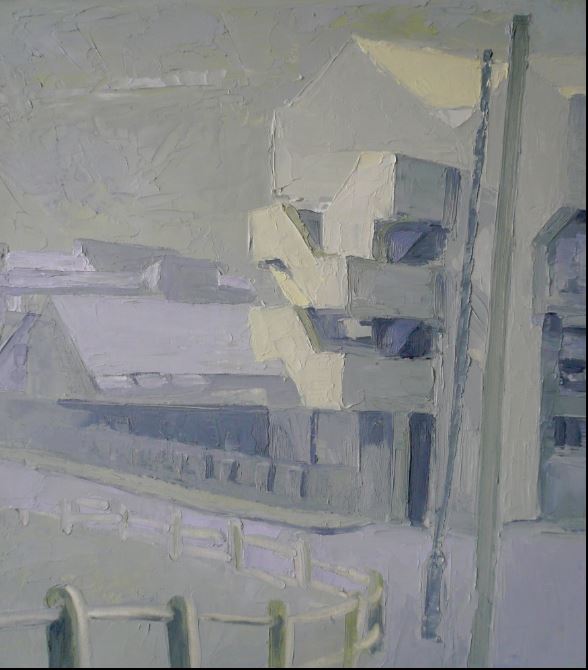
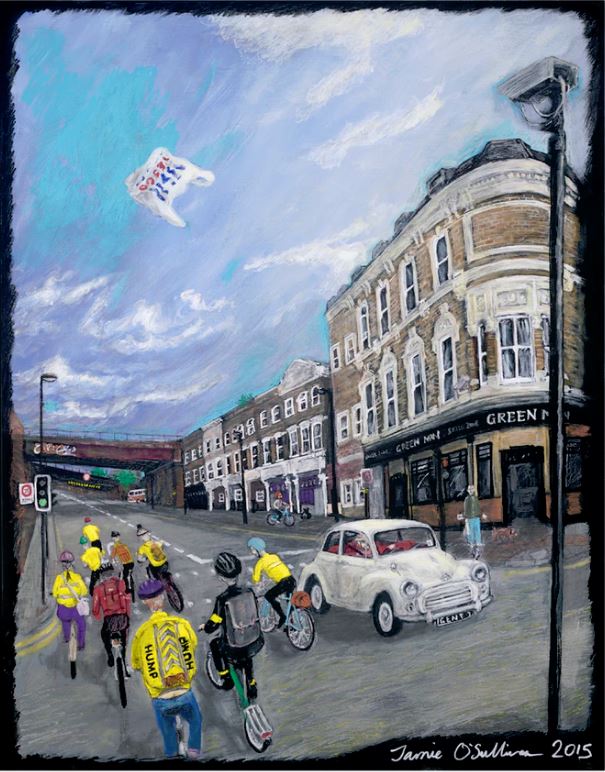
A painting by James O’Sullivan dated 2015 and titled Tour De Loughborough Junction.

Take a look at Jamie’s website at https://jamieosullivan.co.uk/
A painting by James O’Sullivan dated 2015 and titled Tour De Loughborough Junction.

Take a look at Jamie’s website at https://jamieosullivan.co.uk/
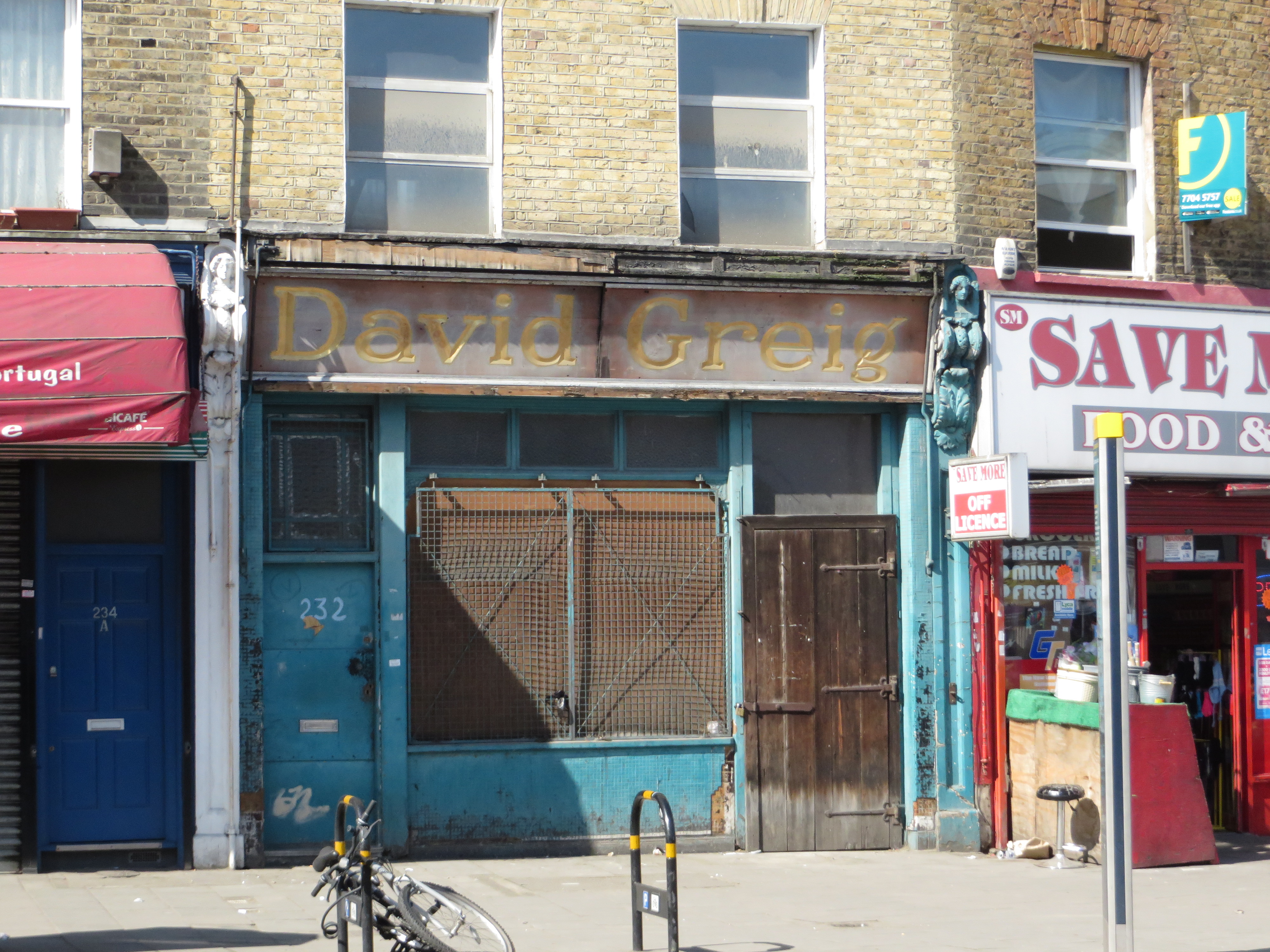
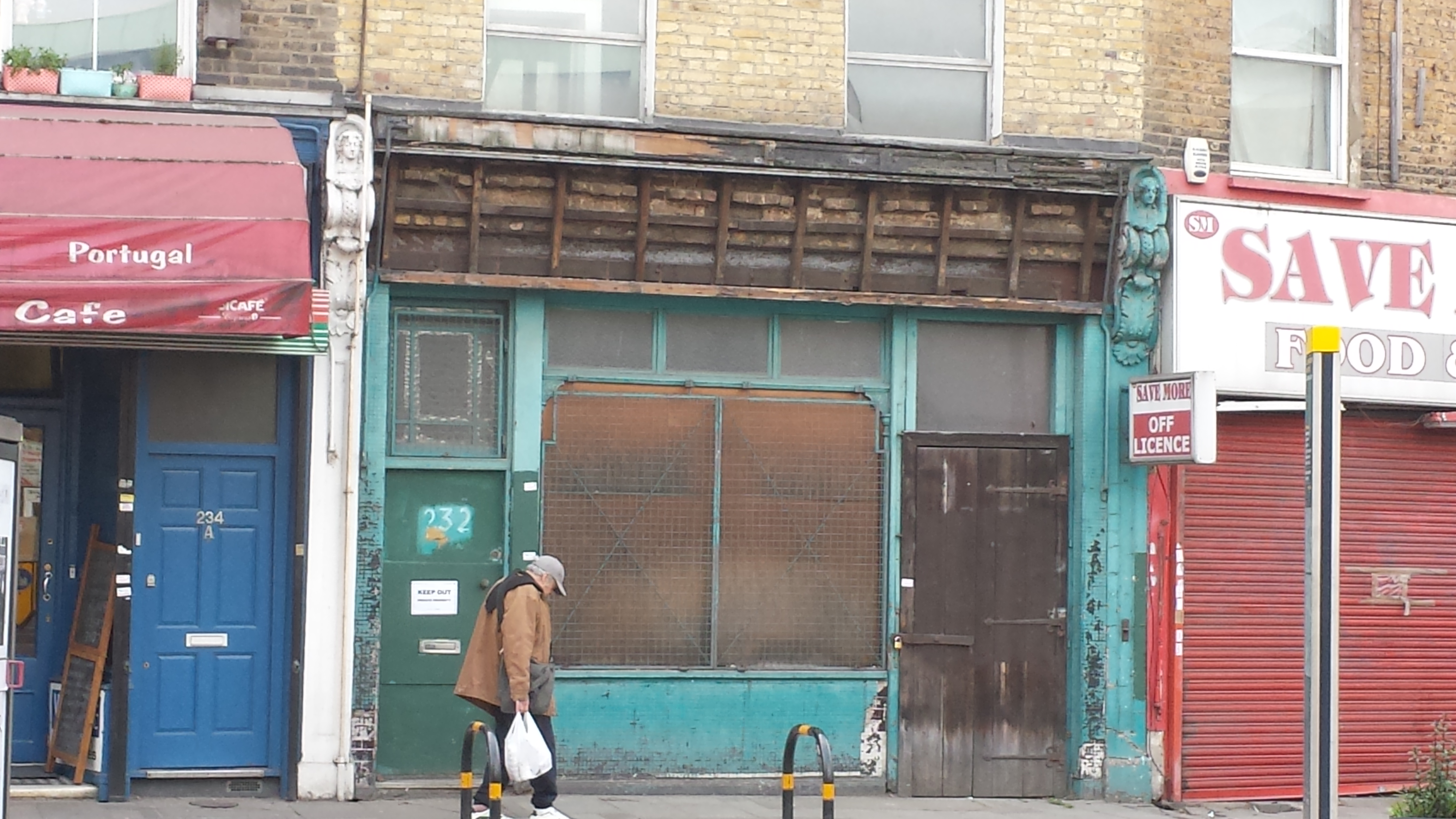
The rather wonderful David Greig sign at Loughborough Junction mentioned in the earlier David Greig – Grocers post has disappeared.

https://loughborough-junction.org/2017/01/01/david-greig-grocers/
1st mentioned by a poster on Urban75 Loughborough Junction chitter chatter on March 14 as having disappeared.

Photo taken 20 April 2017 by Loughborough-Junction.org blog
BrixtonBuzz has a piece about the disappearance dated April 17 2017 at this link
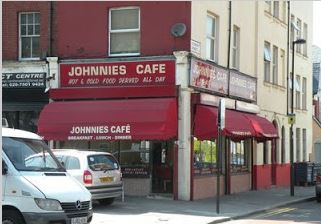
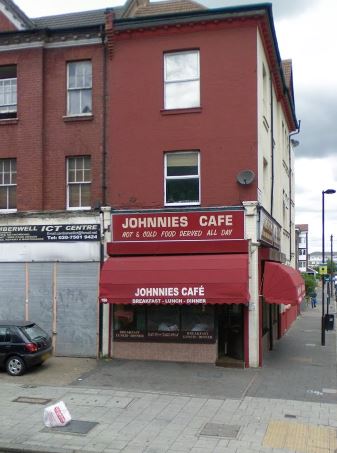
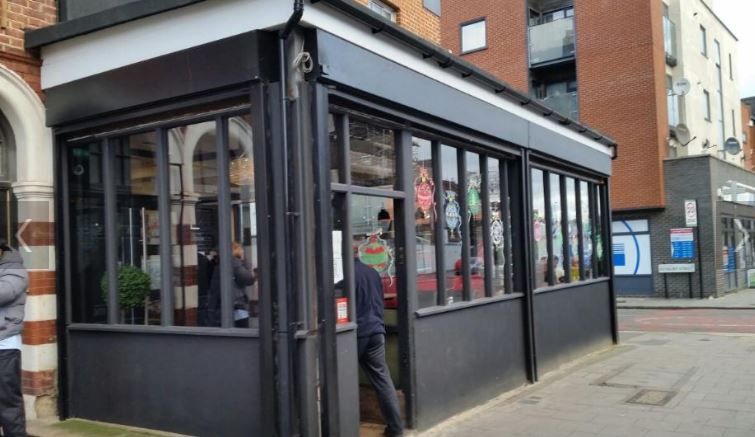
For over 43 years Johnnies Cafe has served up food to Loughborough Junctionites of all kinds. From locals, renters around for a few months or years, construction workers, Kings College Hospital employees and even Police Officers. A truly cosmopolitan crowd.
The space was occupied from 1927 through to 1956 by Harry Lee who was described initially as a Ham & Tongue dealer and then from 1936 as a general Grocer.
In 1969, M Hassan ran a restaurant at 104 Coldharbour Lane, succeeded by Johnnie in 1974. This is an early photo of Johnnies before expansion next door to the left. That was initially a Sweet shop then an IT centre for a while.


Both photos from June 2008.
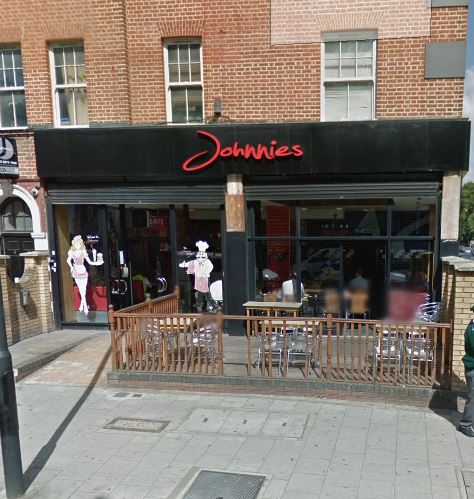
And from June 2014

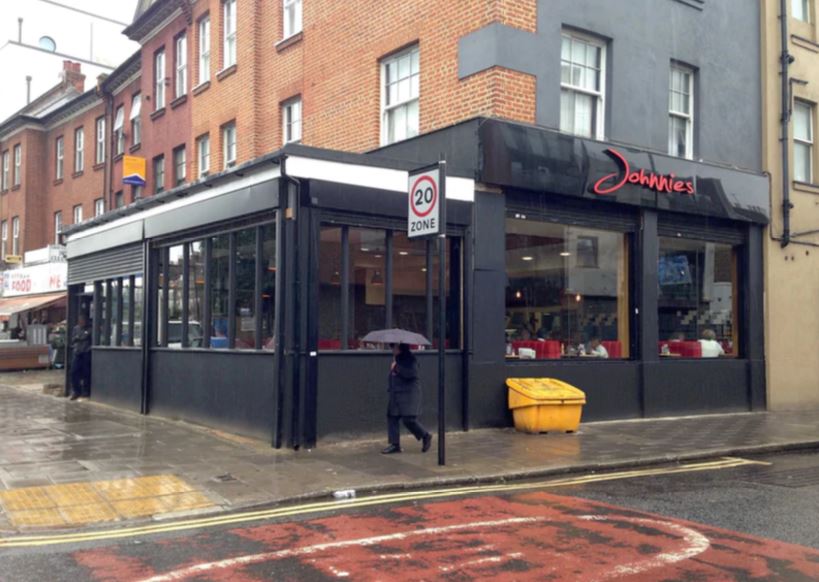
After extensive renovation we now have


Johnnies Cafe is now, as I understand it run by his son Johnny.
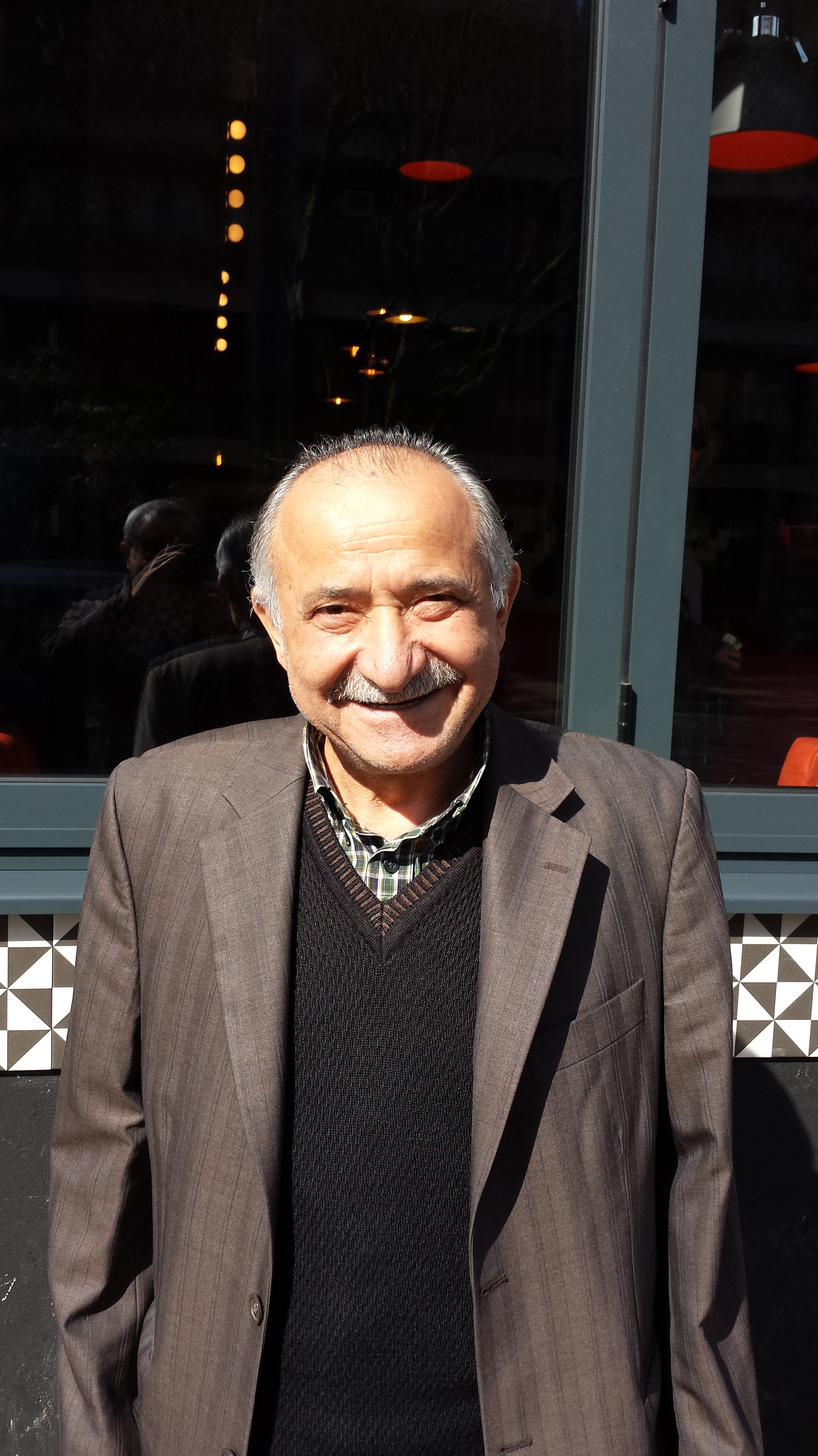
And here is a photo of “Johnnie” himself, taken in March 2017. A true Gentleman.

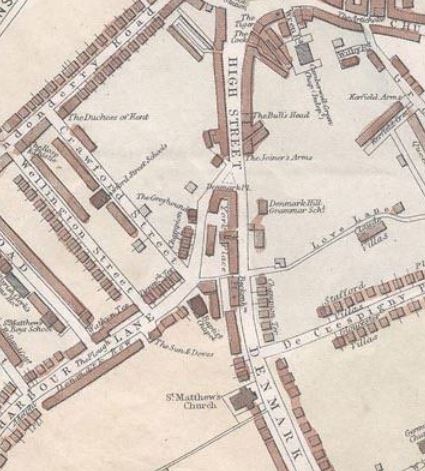
The Cock or Cock Tavern was located at No 3 Denmark Hill on the east side just a little south of The Tiger which some of you will have known as the Silver Buckle.
The Pub is shown in this map extract from, Camberwell & Peckham, Suburbs of London, sheet 5 by Edward Weller, for the Weekly Dispatch, 1868 .
The earliest record I have found is this account of a boxing match. On August 19, 1802, Jem Belcher was visiting Camberwell Fair with friends. Jem was one the country’s leading bare fist boxers.
https://en.wikipedia.org/wiki/James_Belcher
He happened to hear another boxer Joe Berks who is described as “as was frequently the case, had been drinking not wisely but too well.” He was saying to the crowd that he would have “thrashed” Belcher, had he not “cut it” in Yorkshire. Joe Berks was referring to a fight they had on 25 november 1801 , where Joe was defeated after 16 rounds of desperate fighting.
Jem asks Joe what he means by that, and Joe replies “Mr Belcher, i’m a man as sticks to my word, what I say I mean …” So it was arrange the two men should meet behind the back of the Cock Tavern and have a trun on the bowling green. Jow attacked Jem while he was still peeling, however Belcher managed to hit Berks full in the face when both men were pursuaded to meet again on the morrow at Harry Lee’s house, The Black Horse in Oxford Street. Jem was agin victorius after 14 rounds.
The 1st landlord listed is William Young in Pigot’s Directory in 1826, with Thomas Ongley listed as landlord from 1839 through 1856 also Pigot’s Directory and the Post Office Directory.
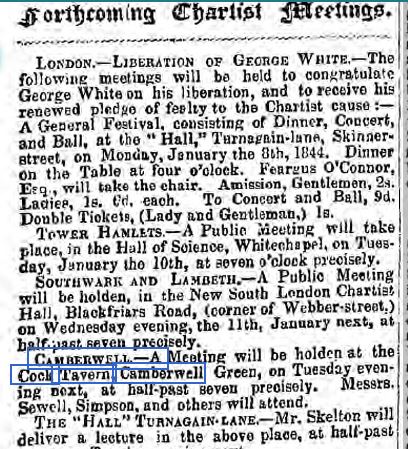
The Cock Tavern was often the location for meetings of The Chartists in the early 1840’s as per this extract from the Northern Star and Leeds General Advertiser dated 30 Dec, 1843.
In The Era newspaper, Richard Dalby is listed as leaving in November 1867 with Thomas Charles Carter as the incoming licensee. And again in The Era in November 1871 Rebort Creswick as outgoing and Josh Henning as the new landlord.
Mr Harry Kennett is recorded as landlord in 1877 and an old newspaper report tells of the suicide of 19 year old Ellen Gissing, who in 1877 killed herself by ingesting poison at the Cock Tavern at 3, Denmark Hill, Camberwell, London. She was found by Alice Tetheridge who then called on the landlord, Mr Kennett, for assistance. Sadly it was too late for Ellen, who had taken the strychnine as a result of her shame and fear of becoming, as she put it, “in the family way”, having been seduced by the pub’s unnamed potman. She had written to her Aunt asking her to visit at Camberwell saying “Oh, my dearest Aunt, it is with sorrow and in trouble that I write to you. A month ago I was alone with the potman in the house, when he took advantage of me and seduced me. Since that time I have never had a moment’s peace of mind. I hope and believe that I am not in the family way for it only happened that once. Oh how he insulted me; don’t tell my mother.With a broken heart I shall leave this place, and never again be the girl I have been. Live I cannot”
In 1878, Arthur Bellet Frank is Landlord as listed in the London Suburban Post Office Directory, with Louisa Stedman, a widow, aged 64 in charge as Landlady in 1881. The census that year reocrds her along with her son George (35) Charles (30), Zephamah (32) Priscilla (24) along with John Frankland, (15) as barmand and William Payne (26) as potman a Hannah Vincent (23) as a general servant.
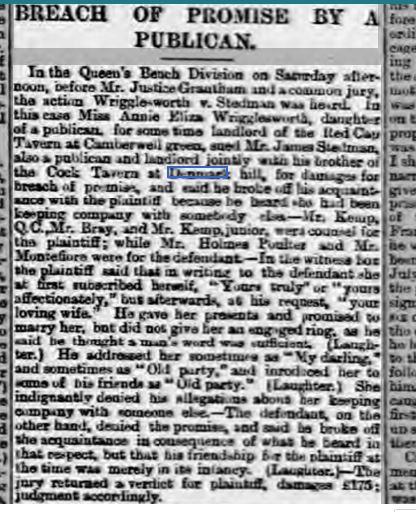
The following court case report from the Sheffield Daily Telegraph from 19 July 1887 tells us about the unusual breach of promises between James Stedman and Miss Annie Eliza Wrigglesworth.
From Lloyd’s Weekly 13 May 1888 we learn of the following tragic death.

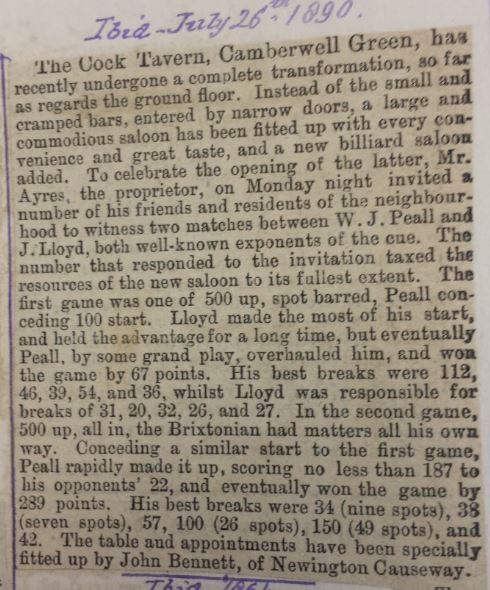
On July 26th, 1890 Mr Ayres, the Landlord had a grand opening of a fully refurbished Cock Tavern. The following report was published.
To be continued….
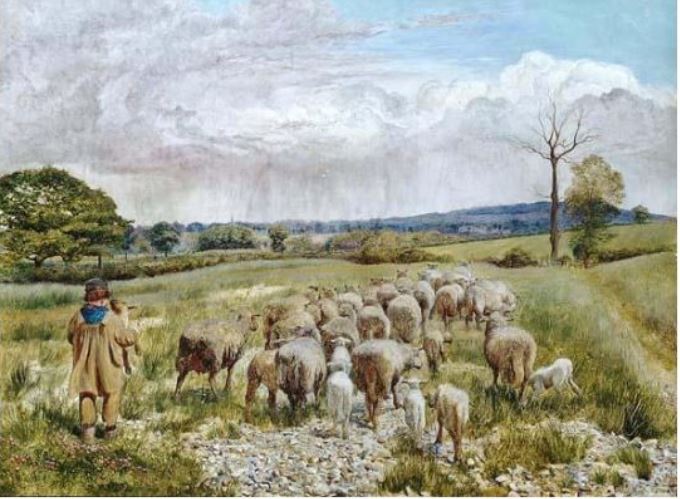
Daniel Alexander Williamson was a member of the Liverpool school of painters, influenced by the pre-raphaelite style. His father was also a painter, as were other members of his family. He was apprenticed as a child to a Liverpool cabinet maker, and moved to London where he stayed from 1849-1857 in Newman Street.
He tried portraiture first but soon abandoned this for landscape.
In 1857 he moved to No 2 Albert Cottages, Denmark Road in Camberwell where he stayed until 1860/1861 when he returned back to Lancashire and settled in the village of Warton-in-Carnforth.
In 1859, whilst living in Albert Cottage he painted the following canvas titled Spring.

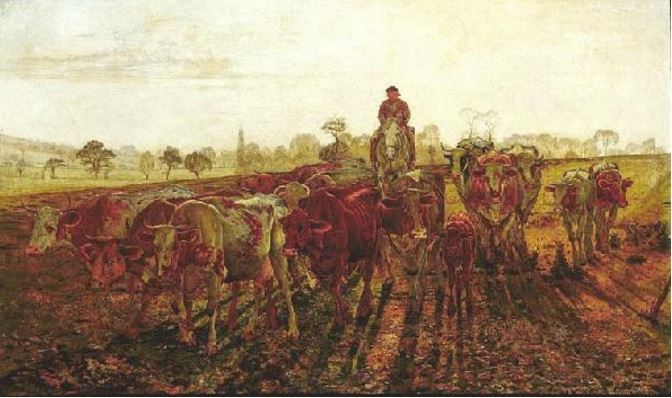
He painted a series of works featuring Cattle on Peckham Common. The following painting is titled Cows going home, 1859.

He died on February 12th, 1903 and is buried in the Broughton-in Furness churchyard.
On 13 February 2010, British Gas had to do essential gas main repairs on Coldharbour Lane at the junction of Hinton Road. This blocked the road to the normal buses 35, 45 & 345. They couldn’t detour south up Hinton Road because of the very low lying railway bridge. The repairs were scheduled to run till the end of March. The buses were diverted via Herne Hill which caused considerable inconvenience to Coldharbour Lane bus users.
After much public pressure including a petition signed by over 700 residents and with assistance from Val Shawcross, Labour member of the Greater London Assembly for Lambeth and Southwark pushed Transport for London into putting on a temporary little hopper which offered free journeys from Brixton to Camberwell whilst the repairs were taking place.

Photographer: unknown
This photo of the 545 was taken by Bob Lear on the 25th February 2010 and was posted to Flickr.

This is Bob’s Flickr link.
Around the middle of 2014, an old shop sign was revealed behind the facade of the long abandoned Futon shop. It was the rather spectacular wooden sign for a David Greig store.

Photo: Nick Stevens, 2015
It was the home to David Greig Butchers, 232 Coldharbour Lane which opened some time in 1929 according to Kelly’s London Directory. In 1928 the shop was occupied by Lilley & Skinner, provisions merchants.
This new photo added in July 2019 reveals the DG logo on the tiling at 232 Coldharbour Lane.

Photo: by kind permission of Chris Patterson. July 2019
The first David Greig shop in Loughborough Junction was located just along from 232 at 238 Coldharbour Lane and opened as a provisions merchant in 1892.


Postcards circa 1905 / 1906
David Greig and his wife had opened their first shop at 54-58 Atlantic Road, Brixton in 1888 and had been very successful. Loughborough Junction followed and then a second shop in Atlantic Road. Mrs Greig attributed their success in a privately published autobiography to David Greig’s success at buying stock at the right prices.

Postcard undated, David Greig, Atlantic Road.

Postcard dated 1912, David Greig, Atlantic Road

David and Annie Greig, 1888
Here is another view also c 1906 from the Linksey Collection at Lambeth Archives.

And another photo c 1912 this time looking east across Loughborough Junction. The David Greig awning is prominent on the left. Postcard from the Johns Collection.

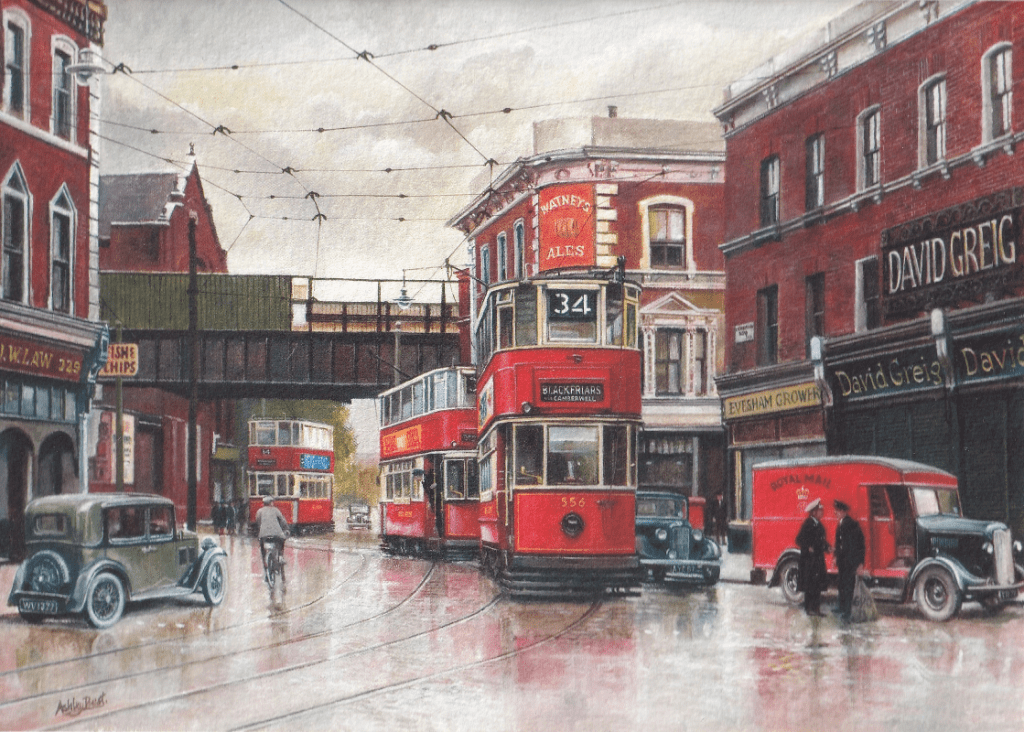
By 1944 David Greig at 238 Coldharbour Lane had expanded to include 236 Coldharbour Lane as well. As the following photo shows. Photo: RJ Harley . Taken from Camberwell, West Norwood Tramways by Robert J Hurley and published by Middleton Press.

David Greig Butchers at 232 Coldharbour Lane closed in 1964 approx. David Greig grocers carried on till 1978 when it too was closed. The Greig family lost several men in quick succession and death duties were particulary severe. The company which at its peak operated more than 220 shops was sold to a succession of companies ending up in the hands of Gateway and were rebranded as Somerfield. Some of the larger stores were sold to ASDA.
Credits
Lambeth Archives
Camberwell, West Norwood Tramways by Robert J Hurley and published by Middleton Press.
A disused waiting room in Denmark Hill Railway Station hosted the Mystical Church of the Comforter. It’s founder was Elizabeth Mary Ann Eagle Skinner nee Roberts. She was born August 30, 1875 in Bethnal Green. She married Arthur John Skinner, who was a teacher at Alleyn’s Dulwich.
She founded the Church in 1901 and it moved into the disused waiting room next to the ticket office at Denmark Hill around 1920.

“One end of the room has been transformed by an altar, painted white and surrounded by the seven colours of the rainbow. Seven steps lead up to the altar, and at the side are two pillars representing beauty and strength. Everything is done by symbols, and the badge worn by the members is a dove, standing in a circle with a seven-leafed branch in its beak” A description from the Lincolnshire Echo 21 August 1926.
“The leader and founder of the church is Mrs Elizabeth Mary Eagle Skinner. Her official title is “The Messenger” but most of the members call her mother. When conducting a service, Mrs Skinner wears white robes ornameneted with mystical signs. She is a Rosicrucian and the signs used refer to some of the inner orders of that society”
https://en.wikipedia.org/wiki/Rosicrucianism

This photo is dated 1926.
from the Nottingham Evening Post, 17 June 1926
Mrs Skinner is a tall, commanding-looking woman.

Mrs Skinner passed away on November 24, 1929 and this report from the Lancashire Evening Post, 27 November 1929 describes the scene.She was buried in Camberwell Old Cementary.

This photo extract shows Mrs Skinner lying in state in her temple.

And this report from the Monmouthshire Beacon, 06 Dec 1929 tells of the crowds that attended.

Sources:
British Newspaper Archive at the British Library.
Looking through Collage – The London Picture Archive I came across this photo dated 1936

It is titled Loughborough Road Estate: Chapel of Repose and comes from the London Metropolitan Archives. On the Ordinance Survey map from 1932-1940 I have marked the on the following extract in white a possible location.

It is at the south end of the Estate. There is no trace of it now in that form.

A mystery.

Published in Town Talk June 1oth 1885, and sourced from Lambeth Local History Archives, Minet Road.
Note: William Temple was the Landlord of the Golden Lion pub.
Another Note: The Tiger and The Cock were pubs on Denmark Hill at the Green end. The Tiger is still with us.
Further Note: A Job-Master is one who lets out horses and carriages for hire, as for family use. From Webster’s Revised Unabridged Dictionary, published 1913 by C. & G. Merriam Co.