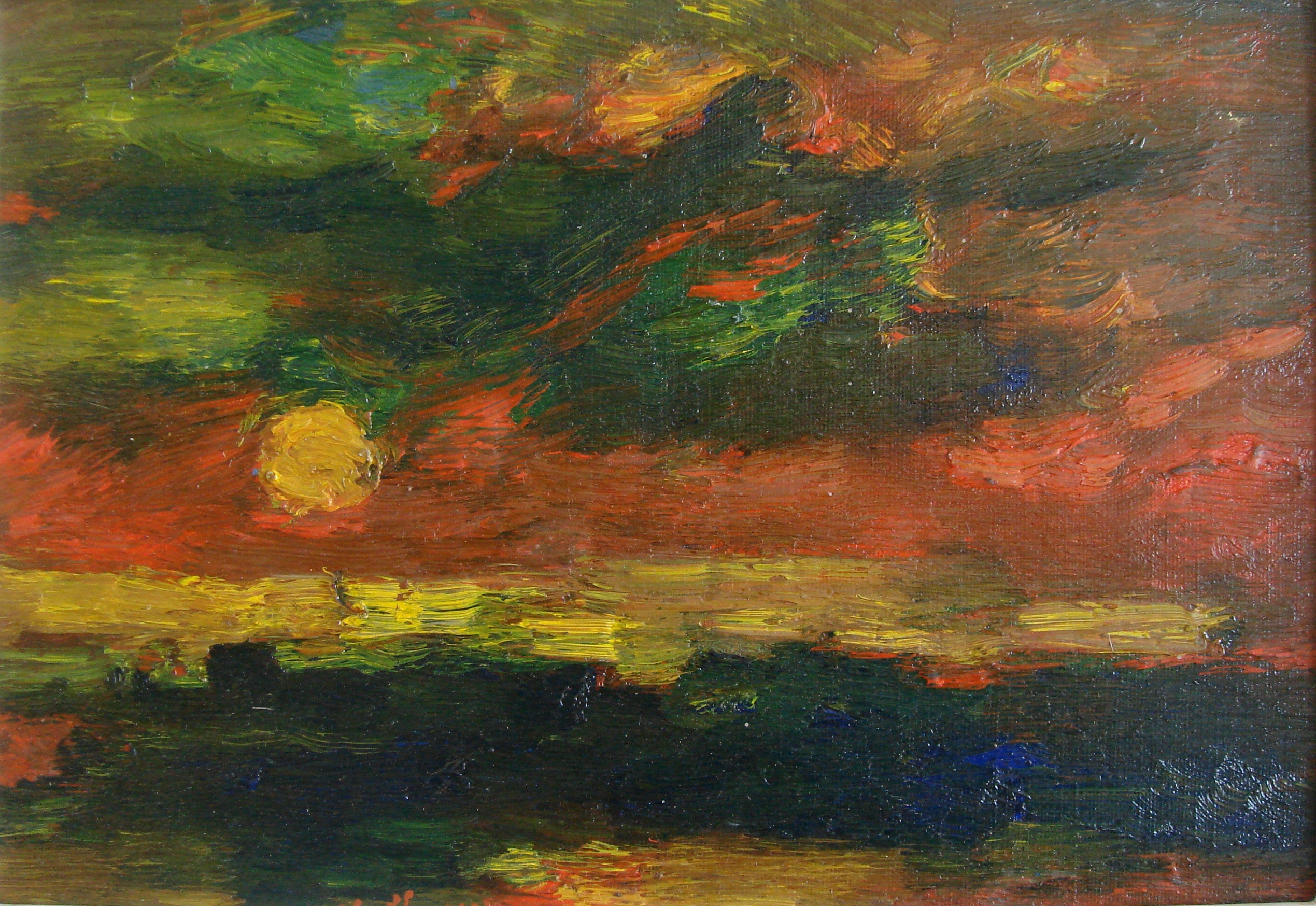
This painting by Miss F Wolsey painted in 1890 is part of the Southwark Council Art Collection. Taken from a snapshot image on the art collection website.
The Golden Lion was located on the eastern side of Denmark Hill, next door to where the HSBC is now, on the corner of Orpheus Street. Thanks to Barry for pointing out my original location error. November 2016 update. It appears the HSBC is now closed.
The first mention of the Golden Lion I have come across is Middleton Bailey’s 1808 Perambulation of the Parish of Lambeth. Held at the Lambeth History Archive, Minet Library.
In 1819, the Golden Lion was used as a temporary court to try urgent cases arising from misbehaviour at Camberwell Fair according to the following report from the Morning Advertiser, 20 August 1819.
In 1838, the Golden Lion was used as a meeting house for the Camberwell Vestry, the then equivalent of the local council.
The 1st landlord recorded to date was Robert Sturt in 1848, who was listed in the Post Office Directories in 1848, 1851 and again in 1856 as a wine & spirit merchant..
In 1861, William Neats is the landlord living with his wife Sarah, son William JSC, aged 21 and daughter Emily aged 12, Also listed in the 1861 census were Hannah Browning, 27, barmaid, Charlotte Davis, 25 the cook and Lucy Wrightson, 18 the housemaid.
In the 1881 census, William Temple is listed as landlord. He was 49 years, a widower born in St Pancras. He lived with his daughters Sarah, 27 & Alice, 18 and a son Edward, aged 20. The Staff are listed as Eliza Jones, 66 the house-keeper, widow, Bessie A Spaun, 18, barmaid and Emma L Poles, 21 a general servant. On 20 Feb 1891 William Temple was declared bankrupt.
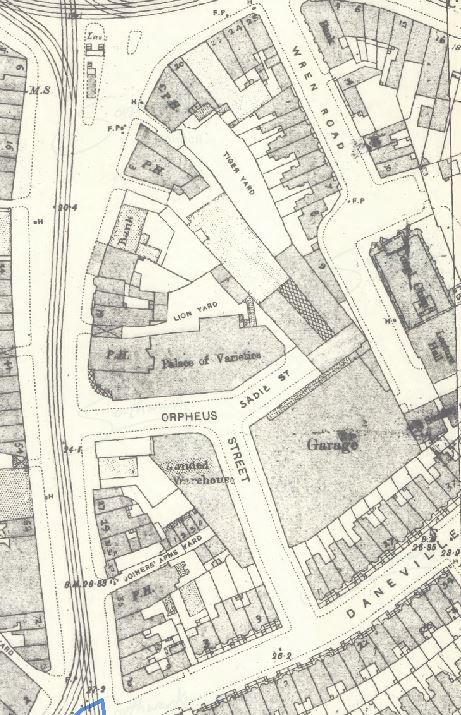
In this extract from the Ordnance Survey map from 1892-96 the Golden Lion is located next to the Palace of Varieties.
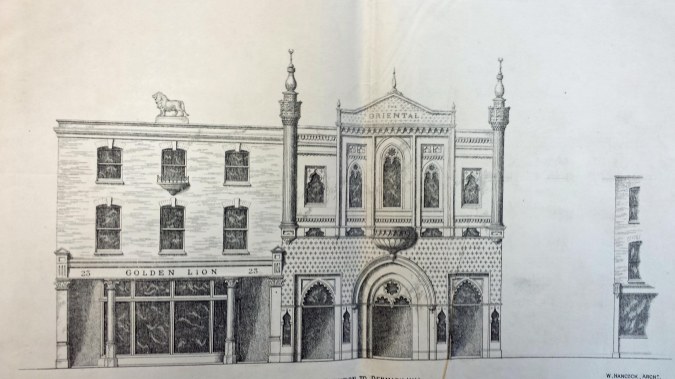
And this architects drawing circa 1896 shows the Golden Lion and the Oriental Palace of Varieties.
In 1896, Charles Mott is recorded in the Post Office Directory as Landlord followed by George Edward Sidebottom in 1901, again in 1905 and 1908.
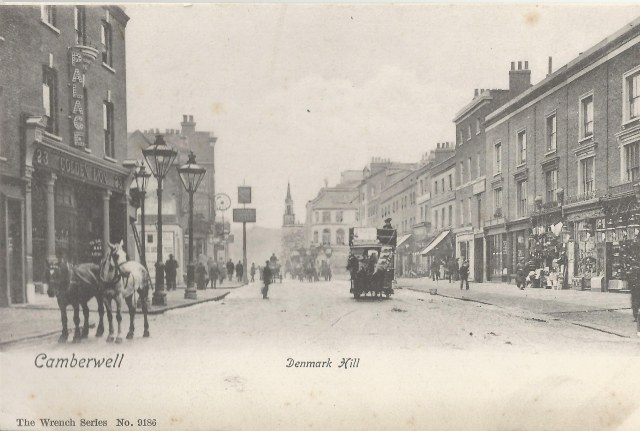
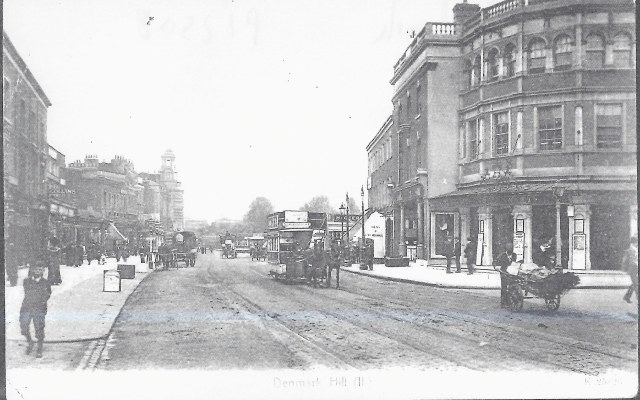
The postcard is undated but probably around early 1900’s.
In the postcard below,the pub just shown behind the Theatre. Undated but similar to above, probably early 1900’s.
Francis Joseph Pepper was the landlord in 1911 through 1919.
The above postcard published by W Greening.
In 1938 Frederick C Twining & Wm Chas Wentworth and again in 1944 are shown as joint Landlords.
The pub sign was photographed by a photo agency in the 1950’s.
In the late 1950s the landlord was Frank Jewell and thanks to Tina Jewell, his niece we have this photo of Frank in the Golden Lion Yard with his rather spectactular AC Saloon. More information on AC Saloons can be found at this link http://www.ac2litre.com/
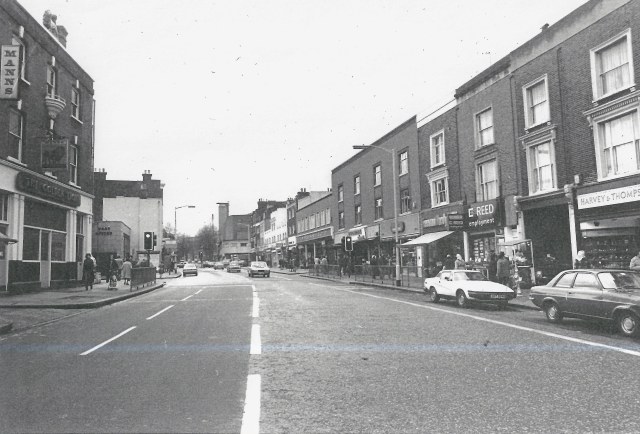
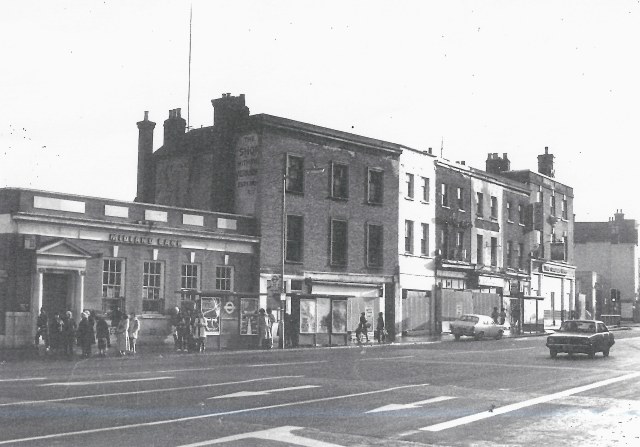
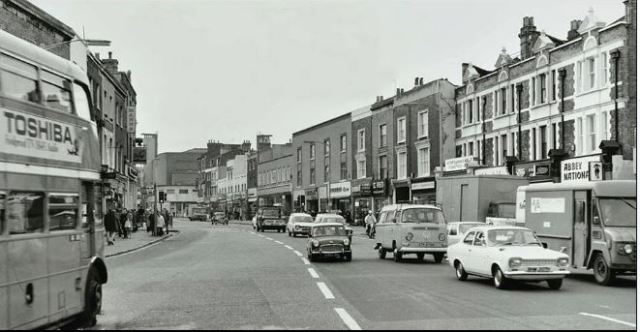
Two more photos from the Southwark Local history collection held in the library in Borough High Street. Undated but probably early 1970’s just before demolition.
If you look carefully you will notice the statue of a lion of the roof of the Golden Lion in some of the photos.
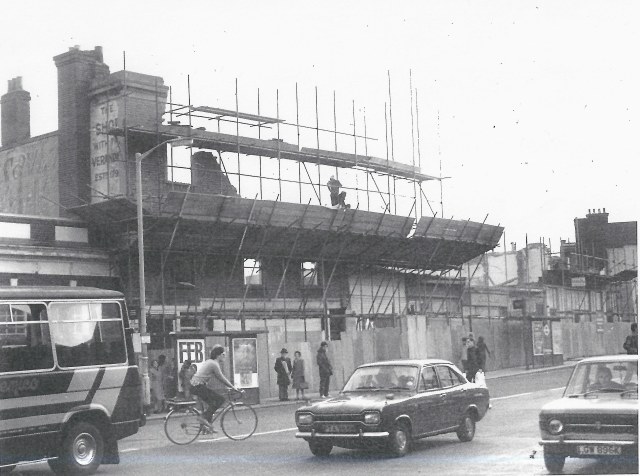
The next two photos show the whole east side of Denmark fenced off prior to demolition and with demolition underway. The whole section was demolished to make way for the Butterfly Walk development.
Here is a photo dated 1976 showing Denmark Hill looking south with the Golden Lion still “alive”.
Henry Gastineau was a painter of watercolours who lived on Coldharbour Lane for over 50 years. Mostly in a house Norfolk Lodge which was built for him in 1827. Prior to moving into Norfolk Lodge, he lived firstly at 24 Denmark Row and then at 1 Adelphi Place, both on Coldharbour Lane.
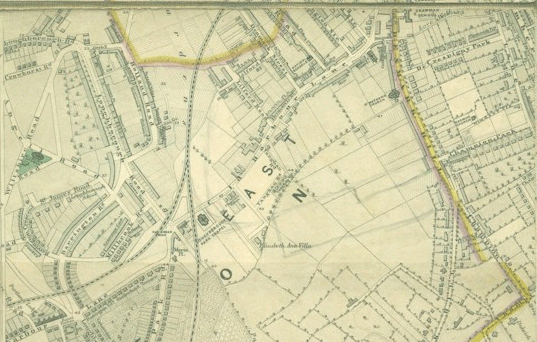
This extract from Stanfords Library Map of London and its Suburbs dates from 1862. It shows Norfolk Lodge loctaed on the south east corner of Coldharbour Lane and Vaughan Road. Further east also on the south side was the row of Terraces known as Denmark Row. In the 1874 street renaming, replacing house names with street number Norfolk Lodge became 145 Coldharbour Lane, 24 Denmark Row became 117 Coldharbour Lane and 1 Adelphic Place was renamed as 121 Coldharbour Lane.
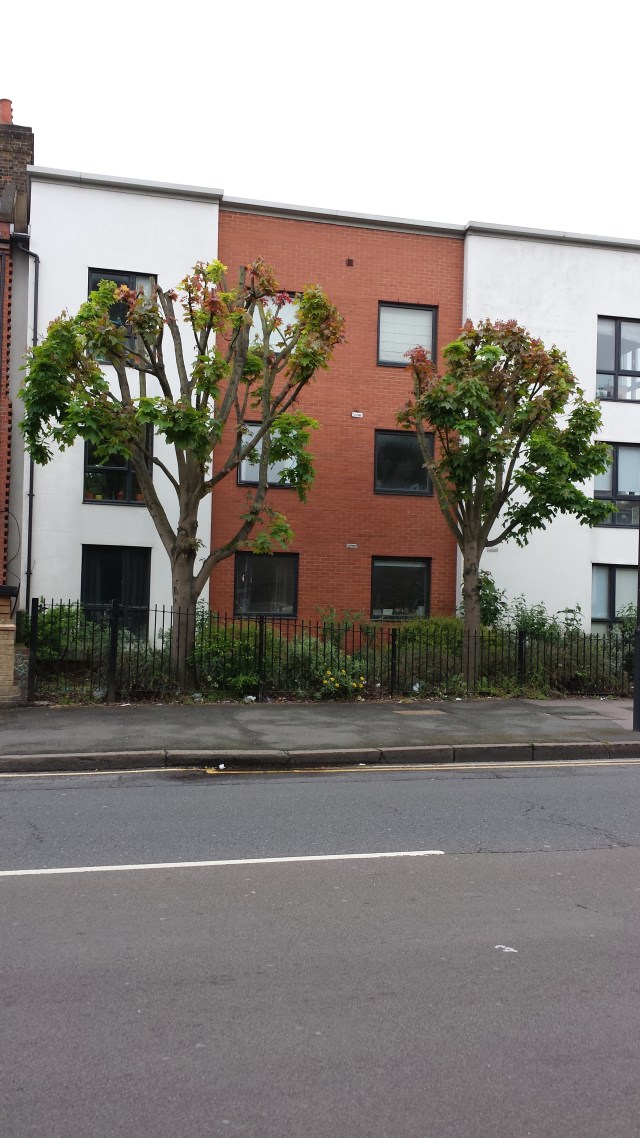
The following photo shows the current building on the site of Norfolk Lodge. Taken in June 2016.
He was born in 1791, the son of Charles & Sarah Gastineau. Both his father -Charles b. 1735 and grandfather -Charles b 1702 were born in Engalnd however his Great Grandfather Matharin was b 1663 in France. Charles Gastineau (father) was a tea-merchant in the City of London. He married Mary Knaggs July 15 1819 and had 5 children: John, William, Ann Jane , Robert and Maria who was also a landscape painter.
Henry Gastineau was a topographer and landscape artist. He trained as a engraver and then studied at the Royal Academy School. Thereafter he travelled widely painting landscapes and buildings. He is best known for his extensive work in Wales. Here is a link to the National Gallery of Wales who hold a large number of Gastineau’s Wales work.
He was elected as a member to the Society of Painters in Water-colours 1818 and went on to exhibit his paintings for 58 years.
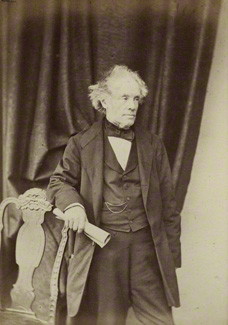
by Cundall, Downes & Co, albumen print on card mount, published 1864
This photograph of Henry Gastineau, part of the National Portrait Gallery collection was published in 1864.
Gastineau’s work features in a number of books including The Surrey Tourist (or Excursions through Surrey) 1821, Excursions in the County of Kent-1822 and Wales Illustrated – 1829.
Henry Gastineau was a good friend of JMW Turner and John Constable and often accompanied Turner on excursions to the Lake District and Switzerland.
Here are a couple of Gastineau paintings featuring London scenes.
This engraving by Henry Gastineau of Fountain Cottage on the John Lettsom Estate in Camberwell in 1811 was published in volume iv of the Beauties of England and Wales.
This painting is titled St Paul’s from Greenwich and dates from 1823.
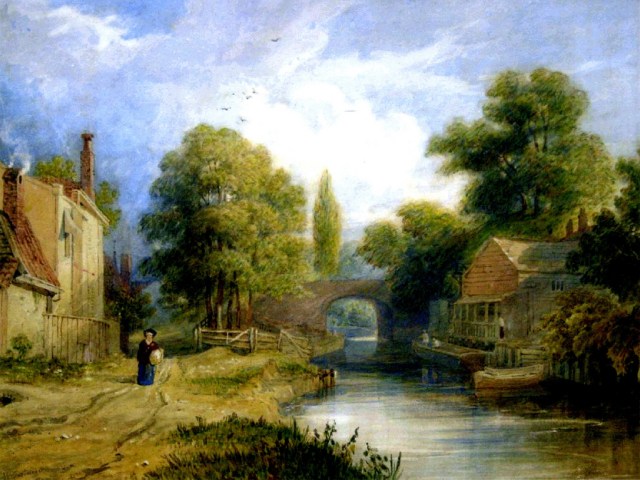
Croydon Canal dated 1836
There is one Henry Gastineau painting in particular I would like to be able to feature on this blog. It is titled Camberwell Landscape c1820 and features a view painted from the Norfolk Lodge back garden looking east over farmland towards St Matthews Church on Denmark Hill and with the spire of St Giles, Camberwell in the further background. It is owned by the Borough of Southwark and was featured on the Southwark Art Collection website, though the image was never available.If any one has a copy I would love to feature in this post. The Southwark reference number is/was GA0258.
October 2016: As luck would have it following on from above, I found a copy of the above painting in The Old Water-Colour Society’s Club, The Fifty-Second Annual Volume, edited by Adrian Burt and published for members only in 1977 by the Society. The Annual titles it St Giles Church, although it is St Matthews Church with the St Giles spire in the background.
Mary Gastineau died on 25th March 1861 in her 74th year. Henry Gastineau died aged 86 years on the 17th January 1876, he was interred at Norwood Cemetary. He was a prolific artist who even in 1875 exhibited 11 pictures at the Society of Painter in Water-colour exhibition. He died according to the Morning Post in its obituary of a gradual decay of nature.
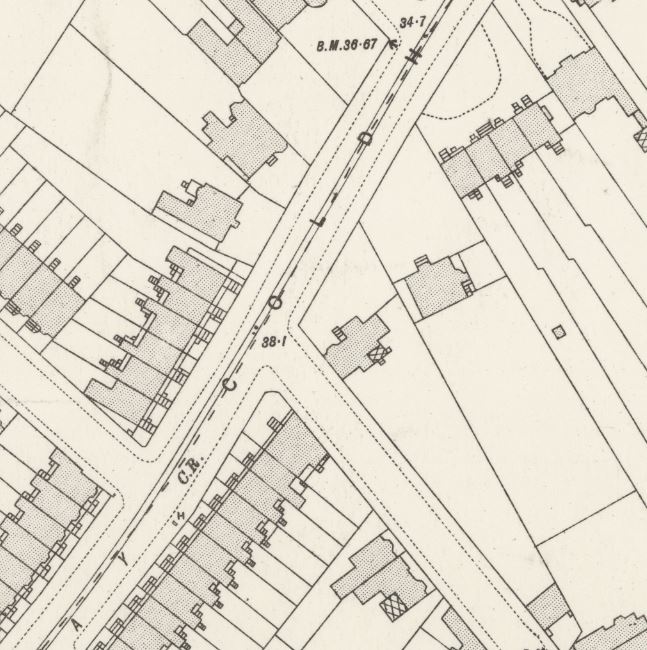
The extract above from the Ordanance Survey map 1893-6 shows Norfolk House second in on the corner of Coldharbour Lane and Vaughan Road, right hand side.
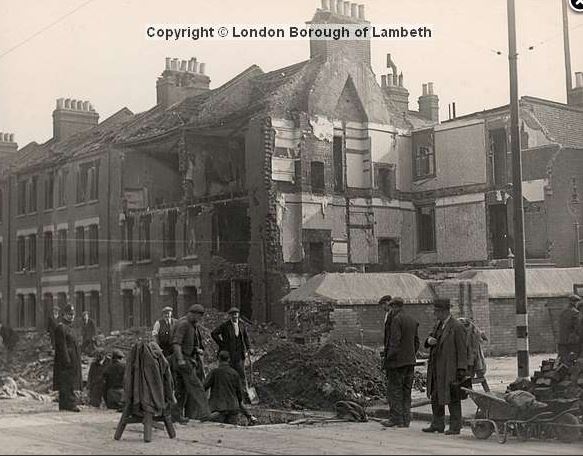
Norfolk House and the other large houses were replaced by the terrace in the photo below at the turn of the 20th century , part of which was destroyed following a bombing raid in WW11.
Thereafter it became in turn a temporary coach park then a permanent coach park used by Redwing Coaches until they moved to Milkwood Road and the housing deveopment in the photo at the top of the page.
Thanks to corresponent Angela, we record that Henry Gastineau’s father Charles (1735-1818) also lived in Denmark Row. Anne-Jane Gastineau, Henry Gastineau’s daughter married Arthur Hills of Woodside in Norwood. She must have inheited many of the Gastineau paintings as Angela tells us that Albert Edward Hills, Annie and Arthurs’s son who made his fortune in Birmingham through the manufacture of steel tubing donated a large number of Gastineau watercolours to the City Art Gallery. His brother Douglas Hills in 1944 also donated paintings to the Museum & Art Gallery in Birmingham.
And it seems that Thomas Francis Gastineau, brother to Henry also lived in Coldharbour Lane in Adelphi Place.
Angela also sent me this fantastic drawing of Henry Gastineau taken from the Illustrated London News 5th Feb 1876.
For many years, a grand house stood on the west side of Denmark Hill around where the Co-Operative supermarket stands now.
It was called Northampton House and it was the home of Spencer Compton, Earl of Wilmington. He was born at Compton Wynates , the family home c 1683 and died aged 70 on 2 July 1743 in St James.
This portrait was painted c 1710. He was born the 3rd son of the 3rd Earl of Northampton and was educated at St Pauls and Trinity College, Oxford.
He represented as member of Parliament 3 constituencies : Eye East Grinstead and Sussex. He was Speaker of the House of Comons 1715-1727, Paymaster for the Forces 1722-1730, Lord Privy Seal in 1730, Lord President of the Council 1730-1742 and finally Prime Minister from 16 February 1742-2 July 1743.
He was created Baron Wilmington in 1728 and then Earl of Wilmington in 1730.
The following two images come from the Southwark Local History archives and show the front and rear view of Northampton House in the time of the 1st Earl of Wilmington.
Both images cleaned up by Nick Stevens, July 2016
In Dewhirst’s Map of 1842 you can see the House and the Grounds.
For a time, Compton became Treasurer to the Prince George of Denmark , husband of Queen Anne.
He was unmarried and when he died in July 1743 he left his entire fortune to his nephew, the 5th Earl of Northampton.
NEW Edit: 29 October 2024. Advertised on ebay a prospectus for a Girl’s Boarding school at Northampton house run by Mrs Norris & Miss Lloyd, it shows a fee of 40 guineas per year with an extra 4 guineas to have your washing done. Dated 1826, 3 years before the Morning Advertiser advert below.
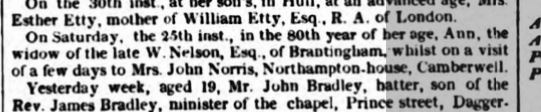
The next record I have come across for Northampton House is as a home to Mr and Mrs John Norris. This advertisement from The Morning Advertiser 05 February 1829
and later the same year from the Hull Packet dated 4th August 1829
.
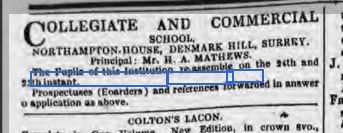
Next, we have records from 1851, showing that Northampton House is now being used as a school run by Mr HA Matthews.
This report on a public examination of Northampton School pupils in The Era, 19 December 1859
.
And again, another advertisment dated 11 May 1861 in the Cambridge Chronicle & Journal
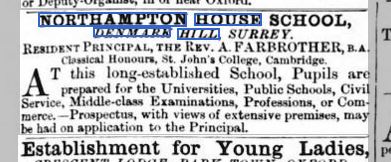
By 1868, Northampton School was under the headship of The Rev A Farbrother.
On January 30th, 1875 Mr HA Matthews, the former headmaster died aged 69 at his new home Malvern Cottage, Hackford Road, North Brixton and in 1881 Emma Matthews, his wife died in Fenny Stratford.
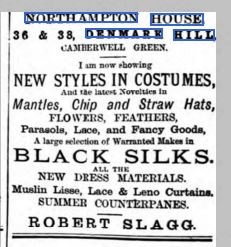
By 1876, Northampton House was now used as a showroom/shop, home to Robert Slagg a costumier and fancy goods seller.
Added October 2016. This drawing in the Lambeth Archives dated c 1890 shows the Drapers & Milleners now in the charge of HB Collins.
According to Mary Boast in her book The Story of Camberwell, published in 2000 as part of the London Borough of Southwark, Neigbourhood History series no 1, Northampton House was demolished in 1908.
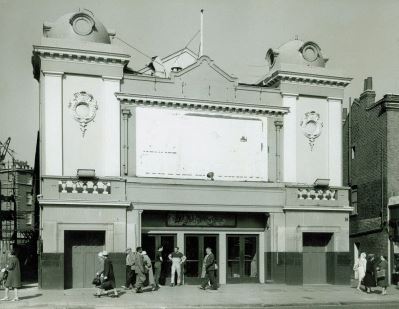
In it’s place was built the Golden Domes Cinema, which opened around late 1913/early 1914.
In 1952 it was renamed the Rex Cinema and renamed again as the Essoldo Cinema from 8th January 1956. It remained as a cinema until it’s closure on 1st August 1964.
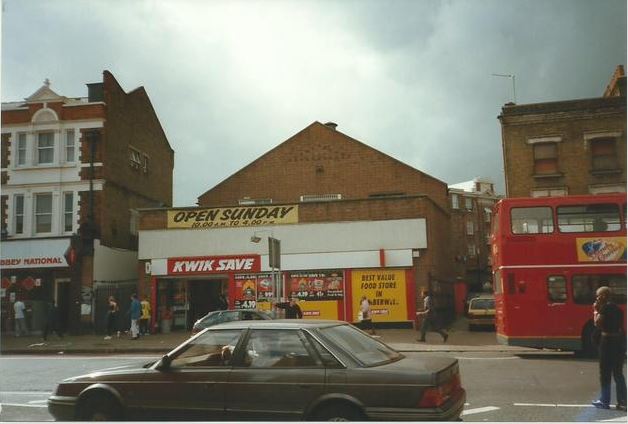
This photo was taken in August 1964 just before it’s closure as the Essoldo Cinema.It then became a series of supermarkets unfortunately with grand facade removed. A Kwik-Save
then Somerfield
Photo by Mike Hedgethorne, 2009
and lastly a Co-operative. (see photo at top of article).
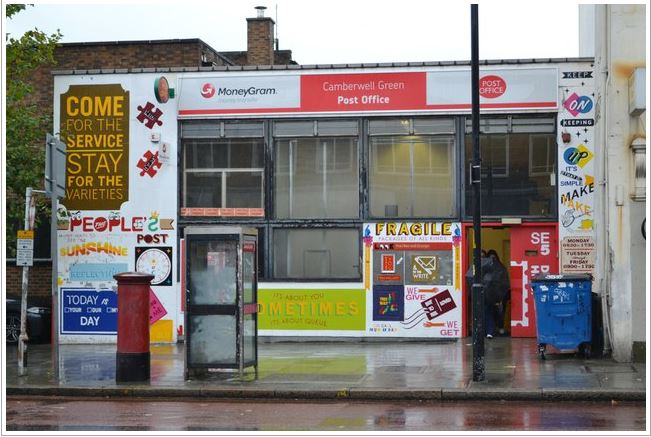
There was a pub called The Bull’s Head in Camberwell for nearly three centuries. Most likely at the same location, on the site of todays Camberwell Green Post Office at what is now 25 Denmark Hill.
This photo was taken by Robin Scott in 2013.
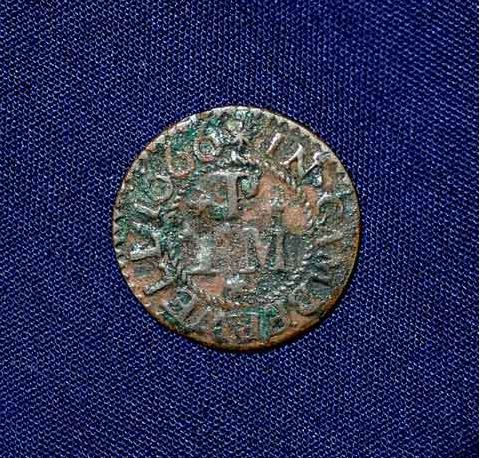
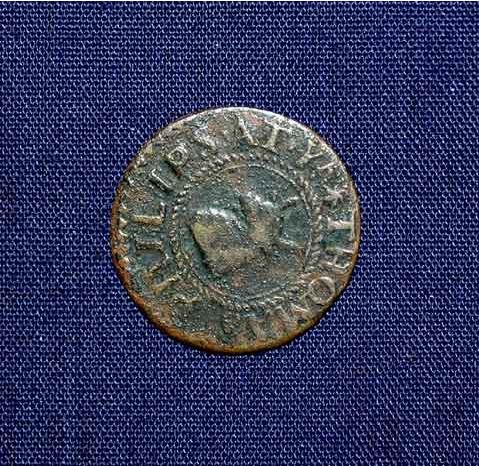
The earliest evidence I can find about the Bull’s Head dates from 1666. At that time and for a few centuries Treasuries could not produce enough small coinage and local businesses often produced their own Trader’s Tokens.
Here is a front and back view of the Traders Token issued by Thomas Philips Landlord of the Bull’s Head in 1666.
In 1826, Chas Drew was the Landlord as detailed in Pigot’s Directory. Both Chas and Elizabeth Drew were witnesses a the trial of Seth Metcalfe who was accused of stealing.
Advert placed in the Morning Advertiser, 23 September 1834. British Newspaper Archive.
Pigot’s records a new landlord in 1839, a Robert Poundsford and again in 1848. Thomas Lewin is mentioned as having died at the Bull’s Head in 1851. He was the Pub Ostler.
In September 1853, William Wright is the Outgoing Licensee and William Welch as the incoming Landlord. In 1856, William Welch is again mentioned in the Post Office Directory as landlord.
In 1861, Edward Lambert(aged 44) is the Licensed Victualler in that years census along with his wife Elizabeth,31 and two daughters Elizabeth,12 and Emily, 10.
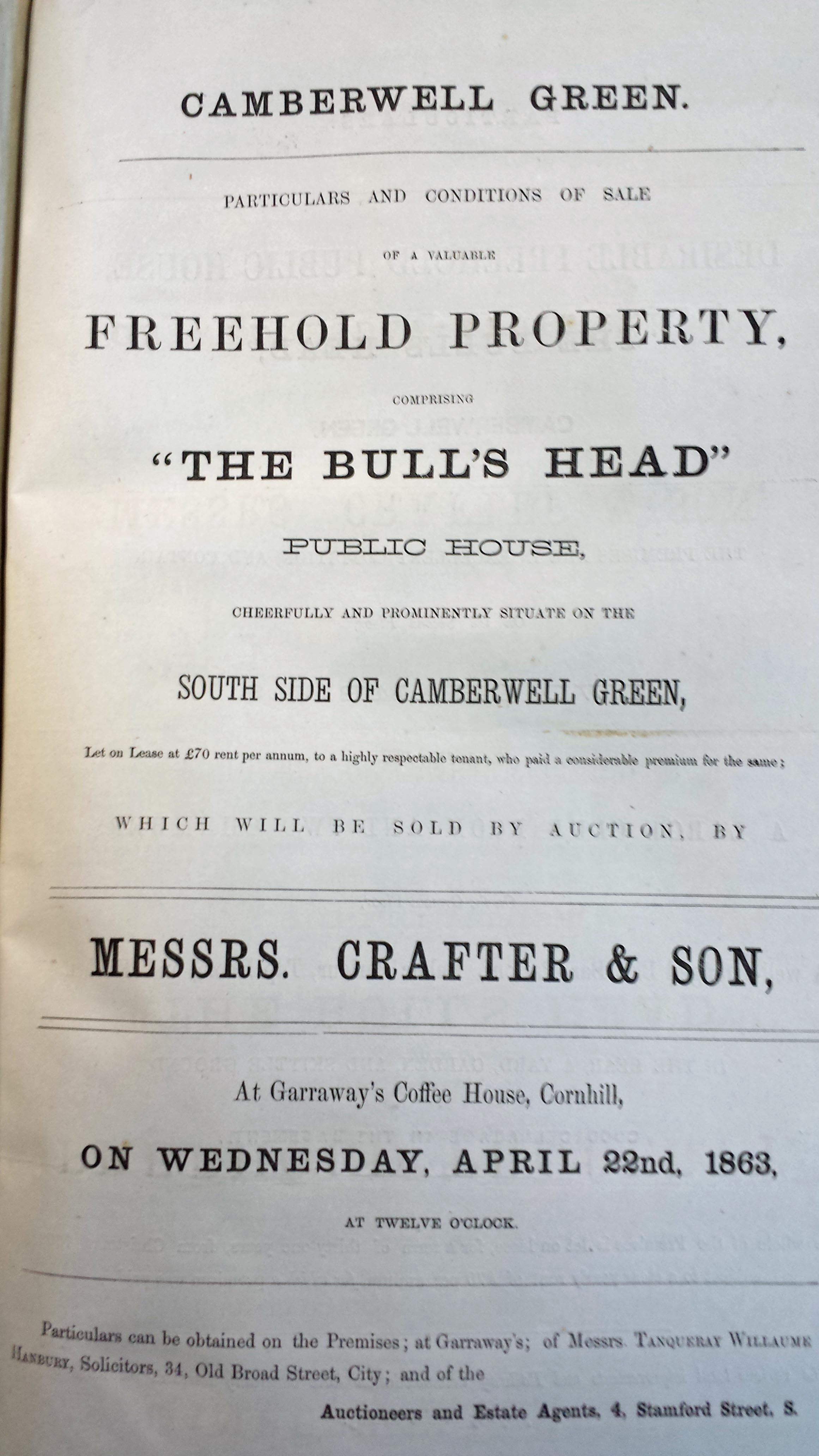
Added October 2016. The pub was up for auction in April 1863 according to the following poster held by Lambeth Archives.
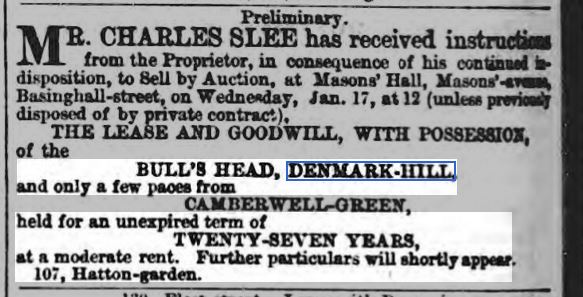
He then put the Pub up for sale again via an advertisment in the Morning Advertiser on 4 July 1866.
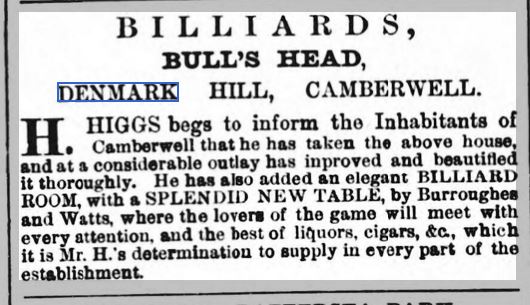
It was purchased by H Higgs who placed the following advertisement in the South London Press on 14 July 1866.
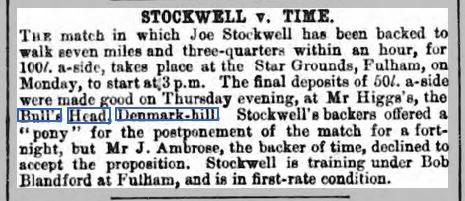
It seems that the Bulls Head was known as a sporting pub with all kinds of wagers taken for unusual events. The Sportsman reports on 28 January 1871 about a walking race.
In 1878, Mrs Jane Raper in recorded in the Suburban Post Office Directory as the Landlady.
In 1881, the Landlord was Henry Bailey, born in 1849 in East Tuddenham, Norfolk. He was married to Anne, 32 and a son Charles 4, Daughter Edith 3, and a younger son Richard 6 months. This was recorded in the 1881 census along with a housemaid Mary Sheppard who is listed as Deaf, Agnes Wollard the Nurse, Louisa Grimwood the cook and William Hutchison the Barman.
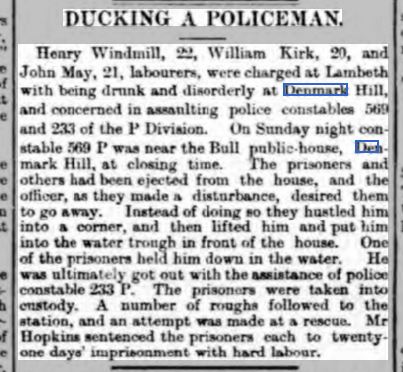
A newpaper report from the Aberdeen Evening Express on 23 October 1890 about ejected customers from The Bulls Head assaulting the Police.
By 1891 Henry Bailey had moved on to run the Royal Navy Tavern in Limehouse.
The pub was renamed The Metropole by 1896 , obviously with a connection the Metropole Theatre established nearby. Mrs Elizabeth Annie Curtis is recorded in the Post Office Directory, 1896 as Landlady.
Herbert Way is listed as the landlord in 1904 in the Post Office Directory.
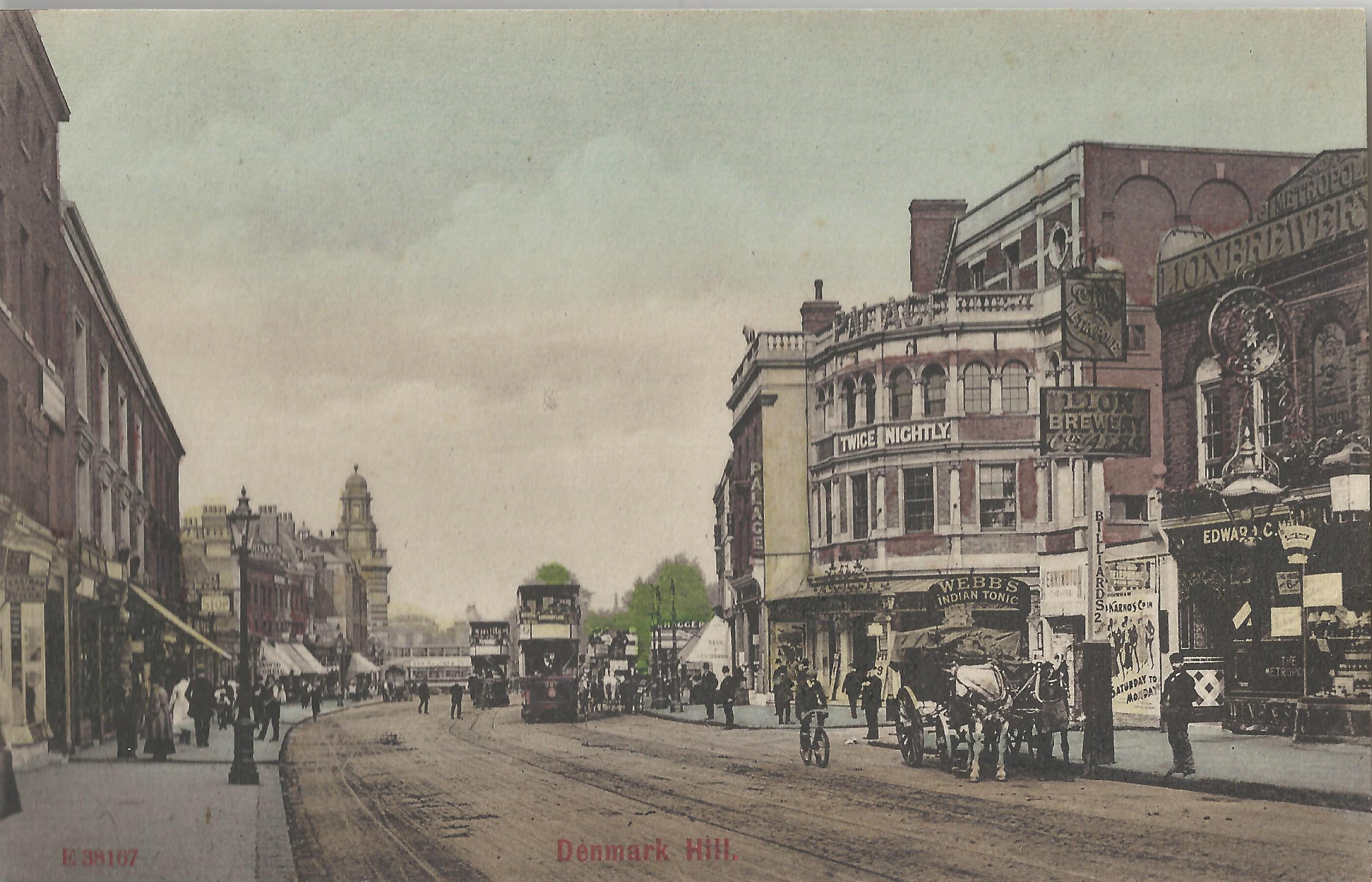
This postcard was published by Stengel & Co, No E38167 showing on the right, both the Camberwell Palace of Varieties and the Metropole PH.
The Metropole was closed and demolished circa 1910. It was rebuilt as the Bijou Picture Theatre with Henry Thomas Brickwell as Manager.
In 1773, 30 members of the congregation of St Giles organised the building of a proprietary chapel on Denmark Hill. It is now the site of the present day King’s College Dental Hospital. It was initially used only for Morning and Evening prayers and for preaching.
This etching is by WJ Zincke dated 1796 and comes from Manning & Brays: The History and Antiquities of Surrey (1814, reprint 1974). Part of the Lambeth Archives collection. Looking south up Denmark Hill with the Chapel on the right hand side.
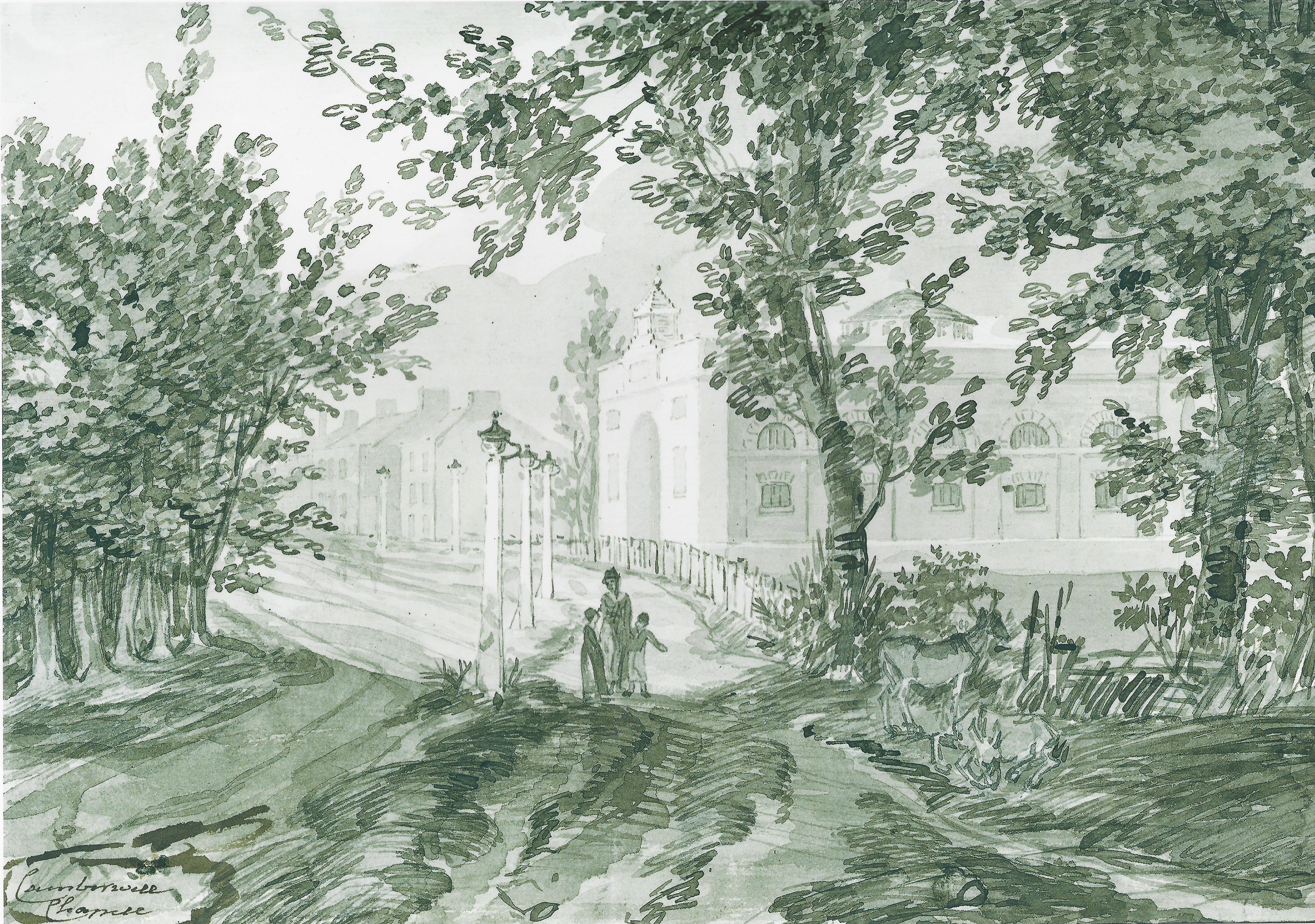
The above is titled Camberwell Chapel, Denmark Hill dated 1797 by George F Zincke and is part of the Southwark Borough Art Collection. As above, looking south up Denmark Hill.
It was said that the inhabitants of Camberwell Green area “found it very difficult or impracticable to procure Seats or accomodation to attend divine service in the Parish Church of Camberwell” (St Giles).
After a further donation of land by Claude Champion de Crespigny who granted a 99 year year lease. He lived on the other side of Denmark Hill in Champion Lodge. This Chapel accomodated 750 people and was built between 1792 & 1794. The cost was met by subsciptions of £100-£150 from around 20 or so people.Each subscriber being entitled to a pew for six persons.
In 1814, following a surveyors report that the Chapel was in need of “very considerable repair and that the roof was in danger of collapsing” members of the congregation was asked for a further subscription to pay for the repairs.
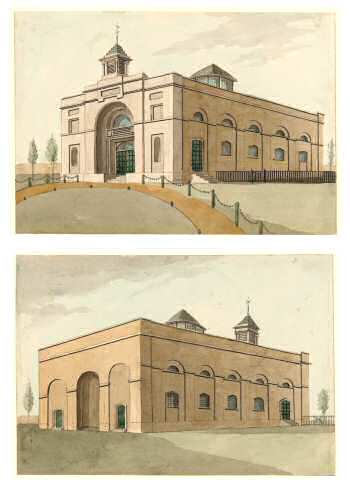
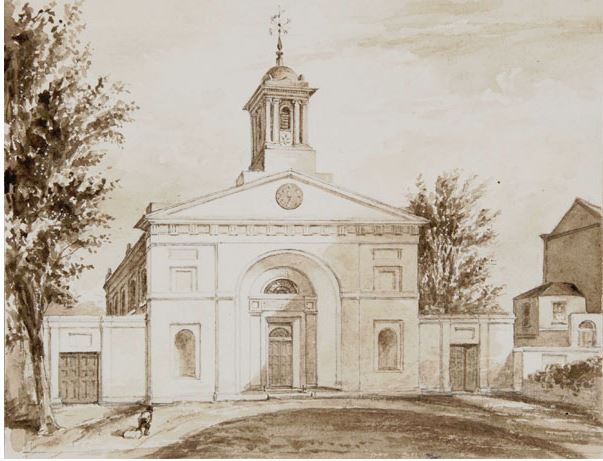
Two views (front and rear) from the Lambeth Archives in Minet Road, circa 1815 stating that Denmark Chapel was built in 1802.
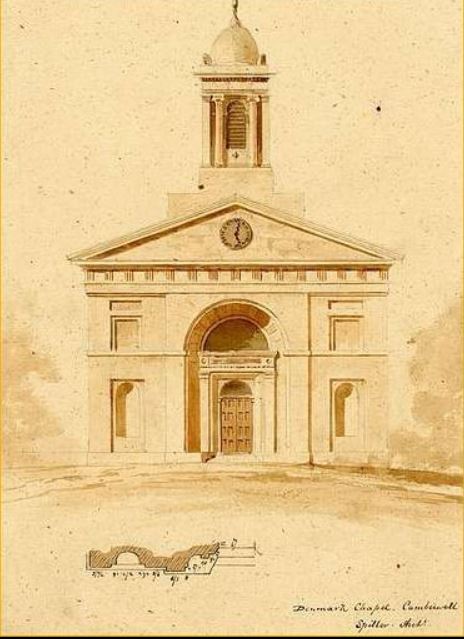
As you have read, there are conflicting accounts of when the Chapel was built. This image held by Lambeth Local History Archives titled as a c 1870 sepia pen and wash drawing collected from Phillips Volumes 1-4 Surrey Illustrations and considered to be an early design proposal. As the Chapel was demolished in 1846, these dates are unlikely. More likely c 1770’s.
By 1830, the Chapel was known as St Matthew’s Chapel.
From the Clergy Database we have the following ministers listed:
1795 Rev. Thomas Sampson,D.D. F.R.S. Chaplain
1826 Thomas Gill, Minister
1826 Robert Crawford Dillon, Minister
1830 Henry Scawen Plumptre, Minister
1831 Thomas Dale, Minister, He was a teacher of John Ruskin in 1833 at his day school. He took on the position in 1831 and resigned in 1835.
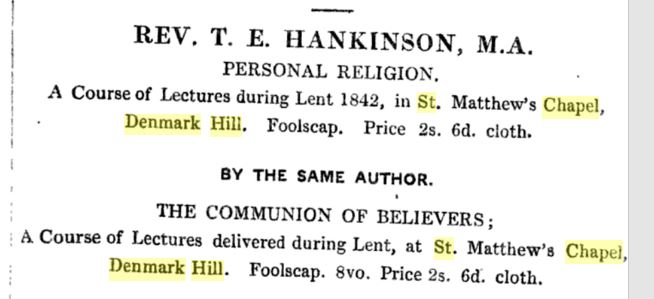
1835 Thomas Edwards Hankinson, Minister. He was born in 1805 and he died in 1843 on the 6th October. He was a divine and a poet. He published many sermons and lectures. His views were strictly orthodox and in 1834 denounced Unitarians as blasphemers.
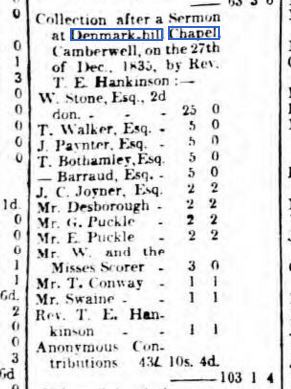
Reported in the Morning Post dated 30 January 1836 a list of members of the congregation who raised money for the General Fund for Relief of Distressed Irish Clergy.
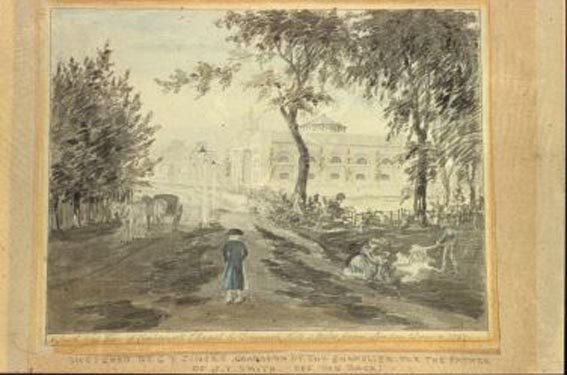
This small monochrome watercolour is dated from the 1830’s and is part of the Surrey Archives. Artist unknown.
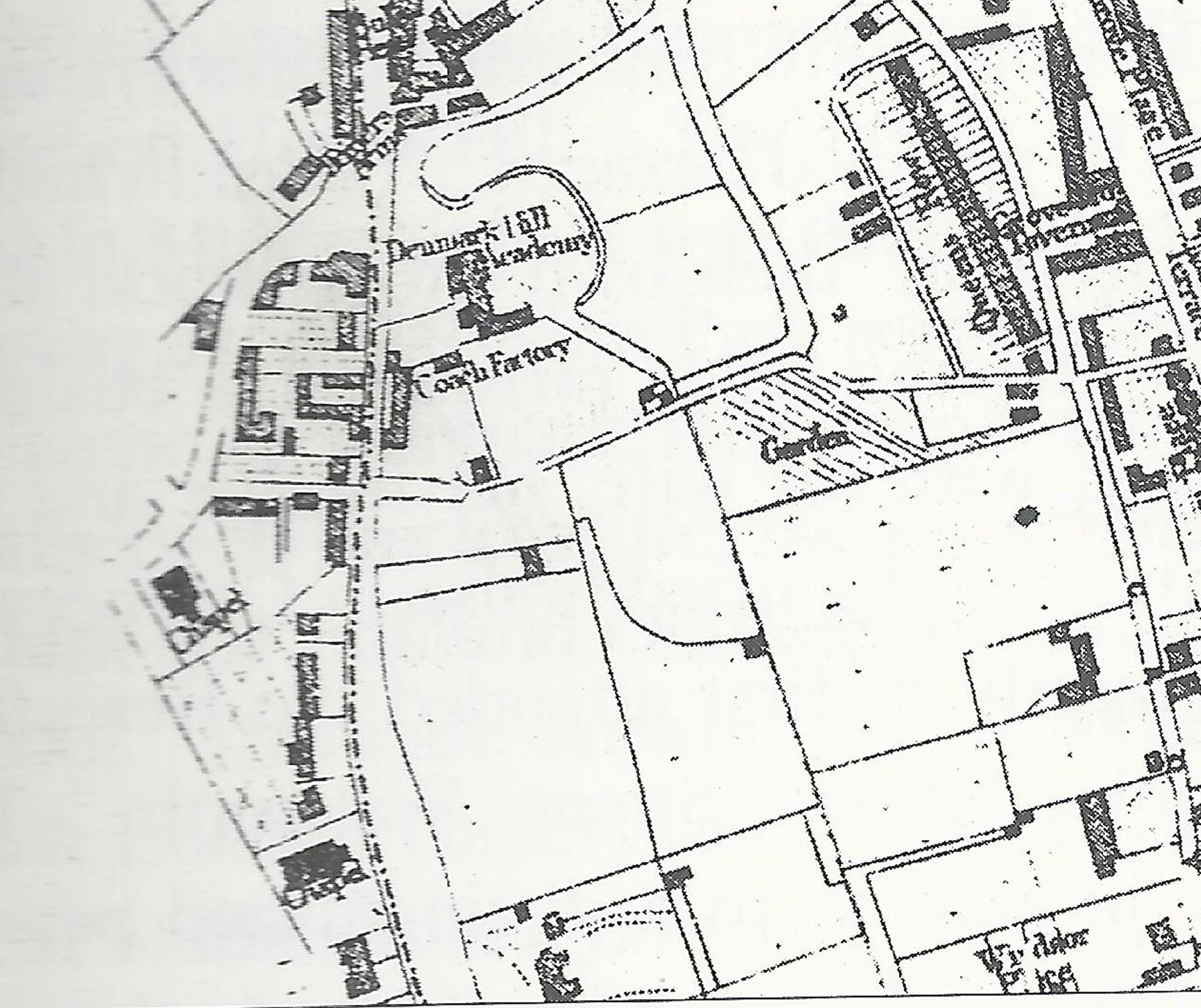
The following is an extract from J Dewhirst’s Map of Camberwell dated 1842. The Chapel is located at the bottom left.
In his Book published in 1844, Douglas Allport states the Chapel was “now a handsome and commodius place of worship, capable of accomodating one thousand persons.
And in 1846, the Chapel was pulled down and a new St Matthew’s Church was built.This followed the establishment of the new Church district of St Matthew, Brixton in 1824.
While doing some research into scenes from films & tv filmed in and around Loughborough Junction, I came across The Intruder (1953) directed by Guy Hamilton for Foxwell Productions and starring Jack Hawkins, Hugh Williams, Michael Medwin, George Cole & Dennis Price.
It tells the story of Ginger Edwards played by Michael Medwin who following demob from the Army enters into a life of crime. Jack Hawkins plays Wolf Merton, Ginger’s commanding officer who sets out to discover how one of his best men took the wrong path.
It features in the background in one scene the Loughborough Park Congregational Church. This clip shows Ginger’s arrival back home after demob and sequences the events that turn his life to the bad…







![Henry Gastineau [ 1791-1876] Illustrated London News, 5th Feb 1876](https://loughborough-junction.org/wp-content/uploads/2016/07/henry-gastineau-1791-1876-illustrated-london-news-5th-feb-1876.png?w=640)










 Loughborough Junction